Tag: zucchini

  • CSA 2026 WINTER WEEK 12

    From Our Farm

    Carrots, Rainbow

    Fennel 

    Kale, Curly 

    Lettuce, Red Leaf 

    Parsley

    Peas, Snow 

    Spring Mix 

    Sweet Potatoes, Yams, Fingerling

    From Our Partner Growers

    Squash/Zucchini Mix – Urban Vegetable Project

    Try out these great recipes we found around the web that feature items from your share:

    Everyday Greens Skillet

    Ingredients:

    • 2 tbsp olive oil
    • 1 clove garlic pressed
    • 1 medium green bell pepper cut to strips
    • 1 medium zucchini squash sliced in half medallions
    • 1 bunch kale torn in bite size pieces
    • 1 cup snap peas
    • 1/8 tsp dried thyme
    • 1/8 tsp onion powder
    • 5 leaves fresh basil
    •  salt & pepper to taste
    • 2 tsp balsamic vinegar (or Pear Cider Vinegar!)

    Instructions:

    1. Add olive oil to stove top skillet on medium-high heat. I like to use cast iron so it sears the veggies a bit during cooking.
    2. Place garlic, veggies, seasoning and basil into the skillet. Stir to combine. Cook on medium-high heat for 4-5 minutes. Stir occasionally.
    3. Turn heat down to medium. Add balsamic vinegar or acid of your choice. Stir and cook another 5-7 minutes or until veggies are soft yet tender.
    4. Serve hot as a side dish or as a veggie bowl.

    Recipe adapted from: https://www.mangiapaleo.com/2018/03/16/everyday-greens-skillet/

  • CSA 2023 Fall Week 1

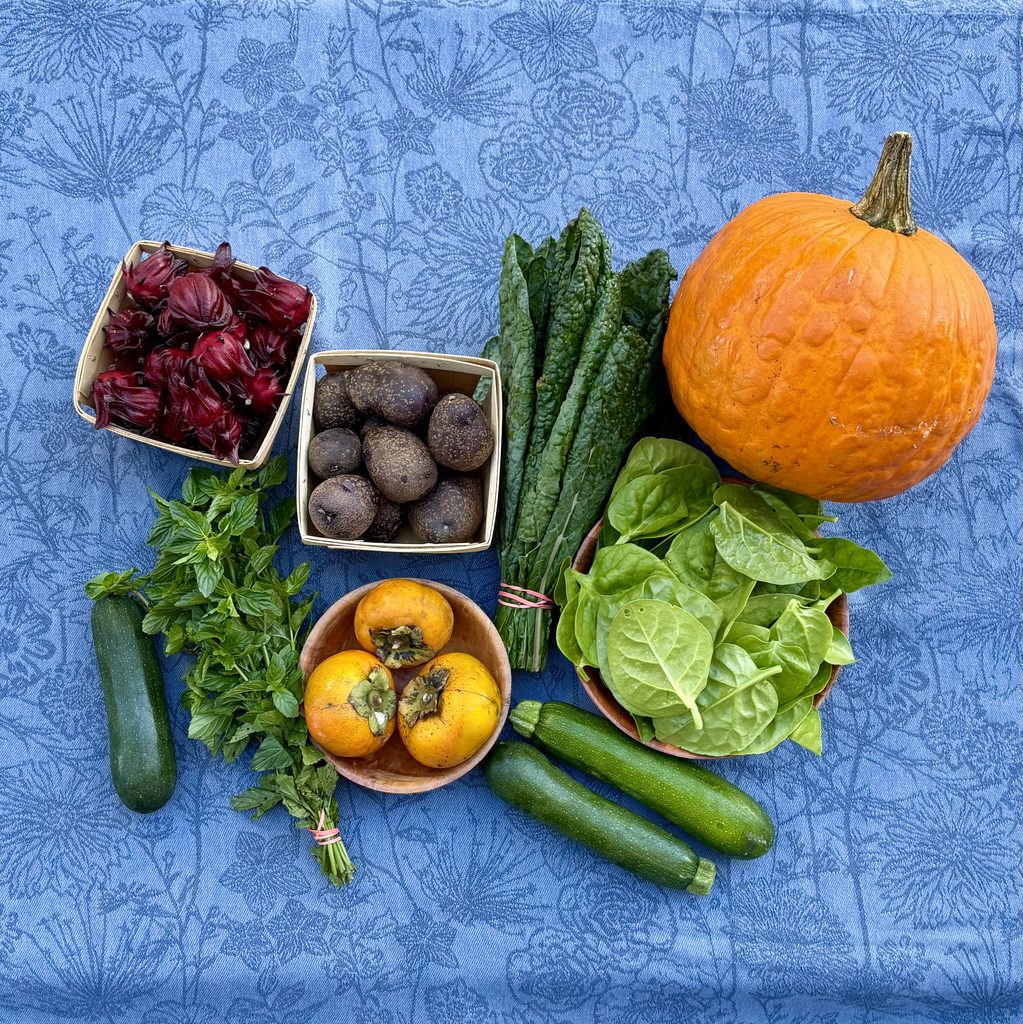
    This week’s share includes:

    Nonconformer Cucumbers

    Fennel (NSOF)

    Curly or Lacinato Kale

    Sweet Habanero Peppers

    Fuyu Persimmons

    Watermelon Radishes (COG)

    Roselle

    Purple and White Potato Mix

    Cherry Tomatoes (WAT)

    Welcome to your fall share! Week one brings us a diverse mix of fruits and veggies, including our first fennel of the season from partner New Sprout Organic Farms up in Appalachia. We’ve just made our final trip of the year to North Carolina. Now that the extreme heat of summer is behind us, we’ll have more variety to offer from our own farm.

    The arrival of fall brings us great news on the personnel front too! We’re happy to report the safe arrival of our seasonal guest worker crew. Each year they come from Mexico to plant, maintain, and harvest crops during our peak growing season of October-June. This highly skilled team is authorized to work on the H2A visa which is especially for agricultural work. This program requires a lot of paperwork, expense and hassle, but every year it has been worth the effort to host these reliable, hardworking, and high quality folks who do amazing work to grow organic food for our community. Bienvendios!

    We hope you enjoy this week’s recipes, all inspired by your share. We love seeing our own kitchen magic! Please tag us on IG @frogsongcsa and show us how you’re loving our tasty, fresh fruits and veggies!

    Fennel/Potato Au Gratin – adapted from oliveandmango.com

    Ingredients:

    • 1-2 large bulbs fennel, stalks removed, halved lengthwise, and cut into ½ wedges
    • 3-4 medium sized potatoes, thinly sliced (white, purple, or red)
    • 2 cups heavy cream
    • 3 garlic cloves, peeled and chopped
    • ½-1 teaspoon chopped rosemary
    • ¼ teaspoon crushed red pepper
    • 1½ cups finely grated Parmesan, divided
    • Salt and freshly ground black pepper, to taste
    • 4 tablespoons unsalted butter, cubed
    • ¼ cup bread crumbs

    Instructions:

    • Heat oven to 425°F. Place fennel and potatoes in a medium size 3-qt casserole dish, sprinkle rosemary, garlic, chili flakes, salt and pepper to taste and 1 cup of the Parmesan. Pour cream and toss everything to combine. Dot with butter. Cover dish with foil; bake for 60 minutes.
    • Uncover baking dish; combine remaining Parmesan and bread crumbs and sprinkle over top and until golden and bubbling and fennel is tender about 20-30 more minutes. Allow to cool a few minutes then serve and enjoy. Garnish with rosemary and, if desired, the snipped reserved fennel fronds.

    Quick Pickled Watermelon Radishes

    Ingredients:

    • 1/2 cup rice vinegar (120ml)
    • 1/2 cup water (120ml)
    • 1 1/2 teaspoons kosher salt
    • 1 tablespoon granulated sugar (13g)
    • 1-quart watermelon radishes, peeled and sliced thinly crosswise

    Instructions:

    • In a medium bowl, whisk together the vinegar, water, salt, and sugar until sugar and salt are fully dissolved.
    • Add the radishes and toss to coat.
    • Lay a clean paper towel on the surface to keep the radishes submerged. Let marinate for at least 15 minutes before serving.
    • Pickled radishes can be packed into a jar with their brine and refrigerated for up to 2 weeks.

    Habanero-Jalapeno Chili

    Ingredients:

    • ½ pound FSO bacon
    • 1 pound ground pork
    • 1 pound ground beef
    • 1 green bell pepper, diced
    • 1 yellow onion, diced
    • 6 jalapeno peppers, seeded and chopped
    • 6 habanero peppers, seeded and chopped
    • 1 pint cherry tomatoes
    • 1 pound kidney beans (cooked)
    • 2 cloves garlic, minced
    • 1 ½ tablespoons ground cumin
    • 1 tablespoon crushed red pepper flakes
    • 3 tablespoons chili powder
    • 1 (28 ounce) can crushed tomatoes
    • 2 (16 ounce) cans whole peeled tomatoes, drained
    • 1 (12 fluid ounce) can beer
    • 3 ounces tomato paste
    • 1 ounce chili paste
    • 2 cups water

    Instructions:

    • Place bacon in a large soup pot. Cook over medium high heat until evenly brown. Drain excess grease, leaving enough to coat bottom of pot Remove bacon, drain on paper towels and chop.
    • Brown beef and pork in pot over medium high heat. When meat is browned, stir in the bell pepper, onion, jalapeno peppers, habanero peppers, garlic, cumin, red pepper flakes, chili powder, crushed tomatoes, whole tomatoes, beer, tomato paste, chile paste and water.
    • Reduce heat to low and simmer for 45 to 60 minutes, stirring occasionally. Add beans and bacon and continue simmering for another 30 minutes.
  • CSA 2023 Summer Week 8

    Beets (COG)

    Galangal

    Muscadine Grapes, (SFO)

    Lacinato Kale (NSOF)

    Green Bell Peppers (WAT)

    Spaghetti Squash (COG)

    Green Zucchini Squash (WAT)

    Yam Fingerling Sweet Potatoes

    Slicer Tomatoes (NSOF)

    Fun fact: wine production in the US began in Florida, thanks to muscadine grapes like the ones in this week’s share (sorry, California). Back in the 1500s, a group of French Huguenot settled near Jacksonville and quickly realized our native grapes could be vinted. The problem was the taste; it just wasn’t like the wines they were used to at home. So, they added sugar. Lots of it. Most Muscadine is still made overly sweet, but surprisingly it wins the prize for highest amount of antioxidants among all the other grapes. It’s the only variety that contains resveratrol in both its skin and seeds (other grapes only have it in their skin). So, if you imbibe, try our simple wine recipe below and raise a glass to our native fruit!

    We’ve also tucked spaghetti squash from partner Clem’s Organic Garden into this week’s box. Food historians believe that before this veggie became a food staple in the Western Hemisphere, it served as a pre-Colombian bowl. Once the natives started to eat it, they loved it for being a great source of fiber and packed with Vitamins C and K. One thing about spaghetti squash though, it does require prep. We share basic instructions along with a decadent four cheese squash recipe to enjoy with your wine. Cheers!

    How to Cook Spaghetti Squash

    Ingredients:

    • 1 spaghetti squash
    • extra-virgin olive oil
    • sea salt and freshly ground black pepper

    Instructions:

    • Preheat the oven to 400°F.
    • Slice the spaghetti squash in half lengthwise and scoop out the seeds and ribbing. Drizzle the inside of the squash with olive oil and sprinkle with salt and pepper.
    • Place the spaghetti squash cut side down on the baking sheet and use a fork to poke holes. Roast for 30 to 40 minutes or until lightly browned on the outside, fork tender, but still a bit firm. The time will vary depending on the size of the squash and can vary from squash to squash.
    • Remove from the oven and flip the squash so that it’s cut side up. When cool to the touch, use a fork to scrape and fluff the strands from the sides of the squash.

    Four Cheese Spaghetti Squash

    Ingredients:

    • 2 spaghetti squash, halved and seeded
    • 1/8 cup extra-virgin olive oil
    • Kosher salt
    • Freshly ground black pepper
    • 1 tbsp. butter
    • 2 cloves garlic, minced
    • 1 tbsp. all-purpose flour
    • ¼ cup milk
    • ¼ cup chicken broth or veggie stock
    • ¼ cup shredded mozzarella
    • ¼ cup shredded Parmesan
    • ½ cup shredded provolone (can substitute cheese of your choice)
    • ½ cup shredded fontina
    • Chopped fresh parsley, for garnish

    Instructions:

    Preheat oven to 400°. On a large rimmed baking sheet, set the squash cut side up; brush with olive oil and season generously with salt and pepper. Bake cut side down until tender, 45 minutes.

    Make sauce: In a large skillet over medium heat, melt butter. Add garlic and cook until fragrant, 1 minute, then stir in flour and whisk until golden, 2 minutes. Stir in milk and broth and whisk until combined. Combine all the cheeses in a large bowl and stir the mix into the skillet, reserving 1/2 cup for topping. Whisk constantly until creamy. Season with salt and pepper.

    Scoop out spaghetti squash, leaving a shell around the skin and add to skillet. Stir until completely combined, then return to squash boats. Heat broiler on high.

    Top with remaining cheese and broil until golden. Garnish with parsley and serve.

    Old-Fashioned Muscadine Wine

    Ingredients:

    • 6 cups granulated sugar
    • 3 quarts filtered water
    • 1 quart mashed muscadine grapes
    • 1 (1/4-ounce) packet active dry yeast

    Instructions:

    In a large, cleaned, and sanitized gallon-sized glass container, dissolve sugar in water.

    Add mashed grapes to water and sprinkle active dry yeast over top, but don’t stir. Cover container with a clean cheesecloth or kitchen towel and place in a dark and cool area, ideally between 68 F and 72 F. Let mixture rest for 24 hours.

    Once a day has passed, stir mixture well and cover again, returning it to a dark and cool area. From this moment on, stir mixture every day at the same time, for a full week.

    After seven days of stirring and resting, strain liquid into another clean and sanitized gallon container with an air lock.

    Fill with additional water to come up to the top of the gallon container. Let wine ferment for six weeks in a cool and dark place.

    After six weeks, strain liquid again and place it in a clean gallon container. Cap lightly for three days to allow for any more fermentation to cease.

    Pour wine into bottles with an airtight cap and store in the fridge. Always store your homemade muscadine wine in a cool place and consume within 3-6 months.

  • CSA Summer 2023 Week 7

    Frog Song Organics
    Japanese Eggplant
    Pineapple Pears
    Sweet Potato Greens
    Ripe Jalapeno Peppers
    Clem’s Organic Gardens
    Carrots
    High Springs Orchard
    Mint
    OSO Sweet Farms
    Sweet Vidalia Onions
    TendWell Farm
    Butternut Squash
    New Sprout Organic Farms
    Grape Tomatoes
    Watsonia Organic Farm
    Zucchini

    The mint in this week’s share follows recent deliveries of powerful medicinal herbs like Tulsi basil and Moringa. Of course these fresh herbs are a delicious, healthy addition to any meal, but they can also be dried for teas or made into tinctures. The process to make tinctures is a cinch! All you need is a jar, high-proof alcohol, and the herbs of your choice. Fill the jar with the herbs, add alcohol, and voilà!  Just make sure the herbs are completely submerged in the alcohol and that the lid is tight.

    Next, wait. Let it steep for two to four weeks. This is when the magic happens. The alcohol will extract the active compounds from the herbs and create a concentrated tincture. When it’s time, strain the herbs out of the tincture using a cheesecloth or a fine strainer.

    Storage is important! Tinctures should be stored in airtight, dark glass bottles in a cool, dark place. It’s also important to label the bottles with the ingredients and date to keep track of their freshness. Done correctly, your tinctures can last for years! We share a recipe for a mint tincture below (you can also use chocolate mint!), along with some yummy ways to use it. Herbal extracts aren’t just medicinal – they’re often delicious as well!

    Mint Extract

    Lightly break up the leaves of one bunch mint to release the natural oils. Place the leaves in a pint jar (full but not packed down). The leaves should have room to swish around and be completely covered by the liquid.

    Many recommend using 80 proof vodka to make extracts; since vodka has little to no taste of its own, it allows the extract to fully be flavored by the plant material. Pour the vodka over the leaves, covering completely. Close the jar tightly, store away from natural light, like the back of a shelf or the back of a cupboard.

    Every day or so, take the jar out and shake it up gently to distribute the leaves. Place it back in the dark. Repeat and store for 2-4 months.

    What to do with your mint extract?

    • Use a drop or two in your coffee, tea or hot cocoa
    • It is delicious in ice cream! Add a tablespoon to flavor homemade batch of ice cream.
    • Use in baked goods along with vanilla extract

    Recipes

    Butternut Squash and Kale Stir Fry

    Ingredients:

    • 2 tablespoons butter
    • 1 tablespoon olive oil
    • 1/2 butternut squash, peeled, seeded and diced.
    • 1/2 teaspoon kosher salt
    • 1/4 teaspoon chile powder (more to taste)
    • Freshly ground black pepper
    • 1 bunch kale, leaves torn, stalks discarded

    Instructions:

    • Heat 1 tablespoon of the butter and the olive oil in a large skillet over high heat. Add the squash and sprinkle with the salt, chile powder and pepper. Cook for several minutes, turning gently with a spatula, until the squash is deep golden brown and tender (but not falling apart). Remove to a plate and set aside.
    • In the same skillet, melt the remaining 1 tablespoon butter over medium-high heat and add in the kale. Toss with tongs and cook for 3 to 4 minutes. Add in the cooked squash and gently toss together.

    Grilled Japanese Eggplant – shared by CookingWithJacque.Com

    Ingredients:

    • ¼ cup Ponzu or soy sauce*
    • ¼ cup rice wine vinegar or other favorite vinegar
    • ½ cup olive oil
    • 1 tablespoon brown sugar

    Slice eggplant very thin lengthwise. Marinate in soy sauce mixture for at least 10 minutes. Lift from marinade and place on preheated grill. Grill for about 2 minutes on each side. Serve with Couscous or rice pilaf and feta cheese.

    *Ponzu is a citrus flavored soy like sauce that adds a complex flavor to this marinade. Soy sauce is a good substitute. Both products are a fermented produce that contains probiotics. Produce such as Japanese eggplant is a prebiotic that works with the probiotics to maintain gut health.

  • CSA Summer 2023 Week 5

    Frog Song Organics

    Fairy Tale Eggplant

    Pineapple Pears

    Shishito Peppers

    Tricolor Potatoes

    Malabar Spinach on the stem

    Watsonia Organic Farm

    Green Cabbage

    Zucchini Squash Mix

    Clem’s Organic Gardens

    Carrots

    New Sprout Organic Farm

    Grape Tomatoes

    Tis the season for peppers! We’ve included a mix of sweet and spicy in recent shares, and this week brings the return of our mild Shishitos. An over-abundance of fresh peppers is a great problem to have this time of year. If you’re looking for ways to savor this taste of summer later in the year but don’t have canning equipment, we suggest these methods:

    Pickling is a great alternative to canning. You don’t need any special equipment, and the process is similar to canning regular pickles. Steep sliced peppers in a 50:50 mixture of vinegar and water, with 1 teaspoon salt per pint. The peppers stay crisp because they are never heated, and after a few days in the fridge they taste like pickled peppers.

    To freeze ‘em,  wash and drying thoroughly before stashing in the freezer. We also recommend removing the stem and seeds, unless you need them for later. For larger varieties, like bell peppers, cut them in half, in fourths, or in strips, and remove the stem and seeds. Put the pieces on a cookie sheet so they aren’t touching, then flash freeze for about 15-30 minutes. This will keep them from sticking together later. Once solid, you can store peppers in a baggie, or any other freezer safe container.

    Then there’s drying. The nice part about this is that reduces storage space. Pop them into your dehydrator, or put them into the oven on the lowest setting. Be patient, it can take several hours for them to dry completely. With smaller peppers, the thin walls lend themselves to stringing whole peppers together by passing a needle and thread through their caps, and hanging them in a warm, well-ventilated space for about two weeks. Remember, the thicker the pepper, the longer this will take.

    Once dried, peppers can be pulverized into flakes in a food processor, or steeped in vinegar to make sauce for sprinkling over cooked greens and other veggies. Dried hot peppers are also great for making homemade chili paste! Place a few dried hot peppers in a dry pan, and toast them over medium-high heat, stirring constantly, for four to five minutes. Then cover with warm water for an hour. Add some salt and a couple of cloves of finely minced garlic, pulverize into a paste.

    Here at the farm, we love the taste and simplicity of this blistered Shishito pepper recipe. Scroll for more recipes inspired by this week’s share below!

    Also, those long stalks long stalks in this week’s share are Malabar Spinach. On a rare occasion our Malabar crop jumps up with some abundant, succulent shoots. Instead of picking just the leaves we bunch these shoots, traditional style. The stalks are fibrous but can be sauteed. We recommend snacking on just the new tendrils and the leaves themselves. 🙂

    Mozzarella, Basil & Zucchini Frittata

    Ingredients:

    • 2 tablespoons extra-virgin olive oil
    • 1 ½ cups thinly sliced red onion
    • 1 ½ cups chopped zucchini or squash
    • 7 large eggs, beaten
    • ½ teaspoon salt
    • ¼ teaspoon freshly ground pepper
    • ⅔ cup pearl-size or baby fresh mozzarella balls (about 4 ounces)
    • 3 tablespoons chopped soft sun-dried tomatoes (or substitute 2 fresh grape tomatoes, chopped)
    • ¼ cup thinly sliced fresh basil

    Instructions:

    • Position rack in upper third of oven; preheat broiler.
    • Heat oil in a large broiler-safe nonstick or cast-iron skillet over medium-high heat. Add onion and zucchini and cook, stirring frequently, until soft, 3 to 5 minutes.
    • Meanwhile, whisk eggs, salt and pepper in a bowl. Pour the eggs over the vegetables in the pan. Cook, lifting the edges to allow uncooked egg from the middle to flow underneath, until nearly set, about 2 minutes. Arrange mozzarella and sun-dried tomatoes on top and place the skillet under the broiler until the eggs are slightly browned, 1 1/2 to 2 minutes. Let stand for 3 minutes. Top with basil.
    • To release the frittata from the pan, run a spatula around the edge, then underneath, until you can slide or lift it out onto a cutting board or serving plate. Cut into 4 slices and serve.

    Carrot Soup

    Ingredients:

    • 1 small onion, chopped
    • 1 clove garlic, minced
    • 2 tablespoons olive oil or lard
    • 6 medium carrots, chopped
    • 2 teaspoons dried dill
    • 4 cups vegetable stock
    • Salt and pepper to taste
    • Garnish with basil or fresh mint (optional)

    Instructions:

    • Sauté onion and garlic in olive oil or lard over medium-low heat. Add carrots, dill, turmeric, pepper, and salt. Sauté 10 minutes.
    • Add stock, bring to a boil, and reduce to simmer for about 30 minutes. Allow to cool.
    • In a blender, puree soup, return to pot, simmer for 30 minutes.
    • Can garnish with basil or fresh mint.